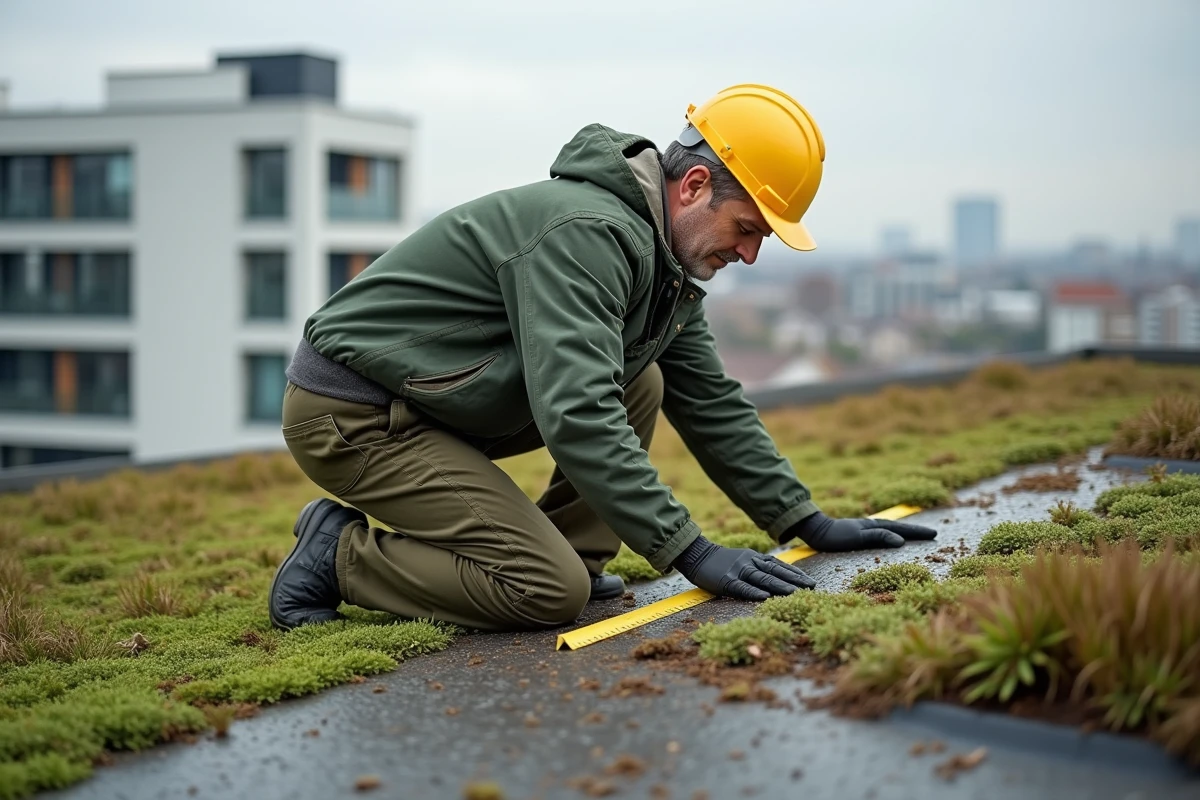
On a renovation site with a nearly flat roof, the question quickly arises: at what slope can a green roof system be installed without risking water stagnation or substrate sliding? The minimum slope for a green roof generally ranges from 2 to 5%, but this figure alone does not indicate the success of the project.
Everything hinges on the balance between water drainage, moisture retention for plants, and the mechanical stability of the whole system.
Water stress and erosion: what the slope really changes on the substrate
It is often thought that the difficulty of a green roof centers on the choice of plants. In practice, the limiting factor is water management, not plant growth. On a low slope, water stagnates and saturates the substrate, which can suffocate the roots and overload the supporting structure. On a steeper slope, water runs down, and the substrate dries out at the top of the slope.
ECOVEGETAL states clearly: the greening of a steep roof must take into account the increased risk of erosion and the water stress related to gravity. Between the two extremes, the range of 2 to 5% corresponds to a compromise where water drains without rushing away too quickly. Understanding the minimum slope for a green roof requires reasoning in terms of hydraulic flow as much as botany.
Beyond 20%, we enter another logic: anti-slip devices (cross beams, nets, compartmentalized trays) and a reformulated substrate are needed to withstand rain runoff. Manufacturers like ZinCo and Sempergreen now offer ranges dedicated to sloped roofs, proving that the technical constraint is manageable, but only if one does not improvise.
Permissible load of the supporting structure: the true feasibility criterion
Before even discussing slope, we should talk about weight. The mechanical resistance of the supporting element conditions the entire project. A water-saturated substrate weighs significantly more than a dry substrate, and on a low-slope roof, water takes longer to drain, which increases the temporary load after a rain event.
The CAUE Occitanie guide emphasizes this point: the success of a green roof primarily depends on the ability of the framework or slab to support the complete system (waterproofing, drainage, substrate, vegetation, retained water). Neglecting this calculation risks structural deformation, especially in older buildings where the load margin is often limited.
Weight factors to check before starting the project
- The planned substrate thickness: extensive greening (a few centimeters) weighs much less than a semi-intensive or intensive system, which can represent several times that load
- The drainage layer, which retains some water and adds weight even in dry periods
- The local climatic overload: snow, prolonged rain, hail accumulation depending on the geographical area
- The actual condition of the framework or concrete support, which may have lost its load-bearing capacity over time
On a slope of 2 to 3%, water stagnates more and the water overload lasts longer. Slightly increasing the slope reduces the temporary weight supported by the structure, which can make a project viable where a strictly flat roof would not be.
Extensive or intensive greening: slope guides the choice of system
The slope not only determines technical feasibility, but also guides the type of realistic greening. On a slope of 2 to 5%, one can consider extensive greening based on sedums and succulents, with a thin substrate and limited maintenance. This is the most common case on the rooftops of collective housing or tertiary buildings.
Beyond 15 to 20%, intensive greening becomes difficult to stabilize. The weight of thick substrate combined with gravity imposes costly retention systems. In practice, steep roofs remain the territory of extensive systems, with solutions like mechanically fixed pre-vegetated mats.
Criteria for deciding between extensive and semi-intensive based on slope
- Low slope (2 to 5%): both options are possible if the structure allows, but semi-intensive requires efficient drainage to avoid saturation
- Medium slope (5 to 15%): extensive remains the most reliable choice, with sedums and low grasses that cling well to the substrate
- Steep slope (beyond 15%): extensive greening only, with anti-slip cross beams and mechanical fixation of the system at the base of the slope

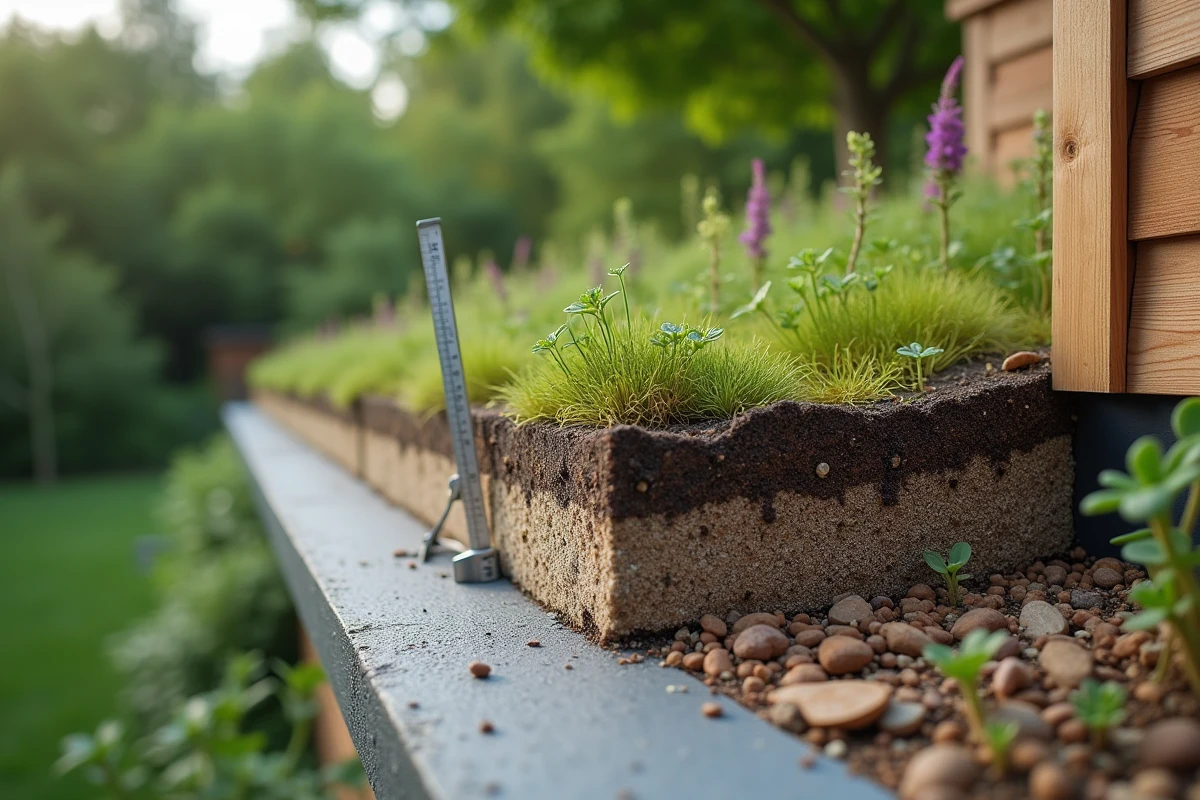
Root-resistant waterproofing and drainage: the layers that make the system last
One can have the right slope, the right load, and the right substrate, but if the waterproofing membrane is not root-resistant, the system is compromised in a few seasons. The roots of sedums are not very aggressive, but those of grasses or more vigorous perennials can perforate a standard membrane.
The root-resistant membrane is the non-negotiable layer, regardless of the type of greening. It is placed directly on the supporting element (or on thermal insulation if there is one), before the drainage layer and the filtering geotextile. Without it, infiltrations appear in a few years, and repairs cost much more than the initial investment.
Drainage plays a symmetrical role: it evacuates excess water while retaining a useful reserve for plants. On a low slope, drainage must be generously sized to compensate for slow flow. On a steeper slope, it’s the opposite: integrated water retention systems are favored so that the substrate does not dry out too quickly in summer.
The right slope for a green roof does not exist in absolute value. It is defined by crossing the roof’s inclination with the permissible load of the structure, the type of greening aimed for, and the quality of the waterproofing and drainage system. Installing an extensive system on a slope of 3% with a proper root-resistant membrane and suitable drainage remains the most reproducible and least risky scenario for a first installation.