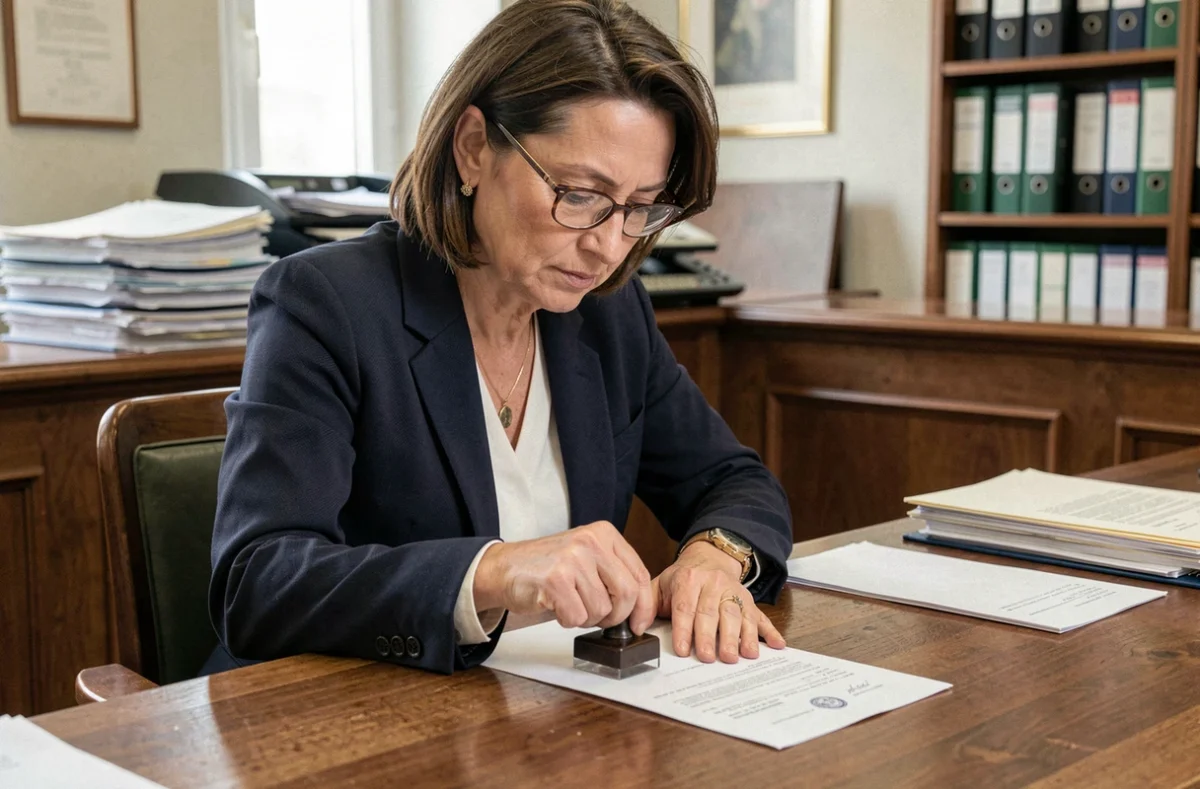
You are asked for a certified true copy for an application file, a notarial procedure, or a document intended for abroad. You have the original document in front of you, a photocopy in hand, and no idea what to do next. The procedure for certifying a photocopy as true to the original depends on the recipient of your document and the country in which it will be used.
Certified true copy at the town hall: common obstacles at the counter
When you go to the town hall with an original and its photocopy, you expect to leave five minutes later with a stamp. In practice, the reception staff sometimes refuse the request, and the reason lies in a legal point that many are unaware of.
French administrations are no longer allowed to require a certified true copy for their own procedures. Since this requirement was removed for internal procedures within the French administration, a simple photocopy is sufficient in the vast majority of cases. As a result, some town halls only carry out the certification if you prove that it is intended for a foreign administration.
Before you go, check with your town hall if it accepts to certify a photocopy as true to the original and under what conditions. Some municipalities require proof from the country or foreign organization that demands this formality.
Certification remains fully valid, but its use in France is now limited to documents intended for procedures abroad or to private organizations that contractually require it.
Who can certify a document as true in France
Not all authorized authorities are equal in terms of availability and cost. Here are the concrete options depending on your situation.

- Your town hall: the agent compares the original and the photocopy, affixes the mention “certified true to the original,” dates, signs, and stamps. This service is free but subject to the usage condition described above (document intended for abroad in most cases).
- A notary: they can certify any type of document. This service is chargeable. You go this route when the town hall refuses or when the recipient specifically requires a notarial act.
- The French consulate or embassy abroad: for expatriate French citizens, the consular section provides this service, usually by appointment. Available slots vary depending on the diplomatic post (the consular section in Nicosia, for example, imposes specific time slots for this type of request).
For documents of a commercial or complex legal nature, some countries require that the certification be carried out by a notary or a ministerial officer. Always start from the recipient’s requirement, not from what is most convenient.
Documents to prepare and the concrete process of certification
You arrive at the counter with two items: the original document and the readable photocopy you wish to have certified. The photocopy must reproduce the entire document, without cuts or unreadable areas.
The agent or notary proceeds to a visual comparison between the original and the copy. If both match, they affix on the photocopy:
- The handwritten or stamped mention “certified true to the original”
- The date of certification
- Their signature and the seal of the administration or the office
You leave with the certified copy. The original is never kept by the administration. Remember to request multiple certified copies in one visit if your file requires it, as each copy necessitates the presentation of the original.
A often overlooked point: the photocopy must be of good quality. A copy that is too dark, cropped, or on which the signature is barely visible will be refused. It is better to scan the document and print it cleanly rather than use an aging photocopier.
Certified true copy and international procedures: apostille and legalization
Having a certified true copy does not mean that your document will automatically be accepted abroad. Depending on the recipient country, an apostille or legalization may be required in addition to the certification.
The reform that came into effect on May 1, 2025, has changed the organization of these formalities. Requests for apostille and legalization are now the responsibility of regional councils or interdepartmental chambers of notaries, rather than primarily the Ministry of Foreign Affairs.
In practice, the process is divided into two steps:
First, you have the photocopy certified (at the town hall, by a notary, or at the consulate). Then you have this certified copy apostilled or legalized, according to the requirements of the destination country. Countries that are signatories to the Hague Convention accept the apostille. For others, a complete legalization is necessary.

Always check the precise requirements of the recipient country before starting the procedure. A certified copy without an apostille will be refused in some countries, and the opposite is also true. Responses vary on this point according to consulates and local administrations, hence the need to inquire in advance.
Identity document and certification: the particular case that often arises
The most common request concerns the certified true copy of an identity document (passport, national identity card). For a procedure in France, a simple photocopy is sufficient for any French administration. No national public organization can impose a certified true copy of your identity document.
The situation changes for a file intended for abroad. Some countries or institutions (universities, employers, banks) require a certified copy of your passport. In this case, the procedure is identical to that described above: original plus photocopy, comparison by the authorized authority, affixing the mention of conformity.
For civil status documents (birth certificate, marriage certificate), the logic is the same. In France, you can directly request an extract or a full copy from the town hall of the event’s location, which avoids the need for certification. Internationally, the certified true copy of an original act remains sometimes the only accepted option.
The reflex to adopt before any certification procedure: precisely identify what the recipient requires, check if a simple copy is sufficient, and only initiate the procedure when certification is truly required.